
Choosing the wrong one costs money. Product damage, wasted freight spend, and shipping delays all trace back to a mismatch between the platform and the job it's doing. This guide breaks down the real structural differences, common uses, sizing, weight capacity, wood species, and how to pick the right solution for your supply chain.
Key Takeaways
- Skids have a single top deck on runners; pallets add a bottom deck for stability and stacking
- Lower build cost makes skids a fit for stationary, heavy, or single-use loads
- Pallets handle frequent shipping, racking, and repeated forklift or pallet jack access
- Wood species and grade affect strength, weight, and price
- Palleton builds custom pallets, crates, and ISPM-15 heat-treated packaging nationwide
Is a Skid the Same as a Pallet? The Core Differences
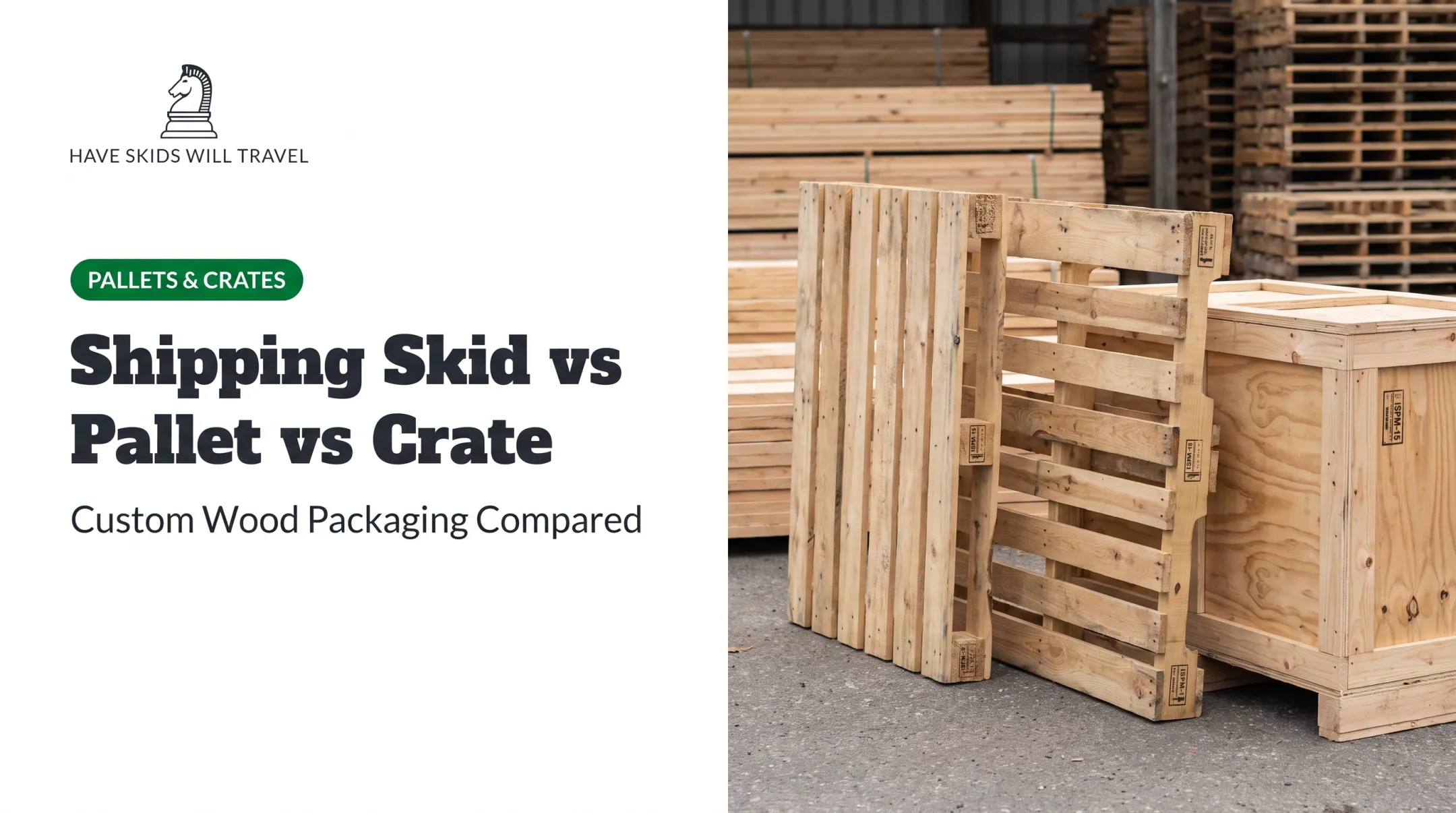
Short answer: no. A skid has one top deck resting directly on stringers or runners. There's no bottom deck at all. A pallet has both a top deck and a bottom deck, connected by stringers or blocks.
This isn't a modern distinction, either. Skids came first. Double-faced pallets didn't show up until the 1930s. The two-faced pallet patent was filed in 1937 and published in 1939, introducing the design that let a loaded pallet sit on top of another one to save floor space.
That bottom deck matters more than it looks. It spreads the load across a wider surface and keeps product from shifting during transport. It also gives forklifts and pallet jacks a stable place to lift from. Skids, without that second deck, are easier to drag or slide across a shop floor, but they don't stack or ship nearly as well.
Quick comparison:
| Feature | Skid | Pallet |
|---|---|---|
| Deck configuration | Top deck only | Top and bottom deck |
| Forklift access | Limited, often single-entry | Two-way or four-way entry |
| Stacking capability | Poor to none | Good, especially block pallets |
| Mobility | Easy to slide/drag | Requires lifting equipment |
| Typical cost | Lower | Higher, due to added materials |

The terms get used interchangeably in everyday warehouse talk, but the structural gap explains why one shows up on a shipping dock and the other shows up under a lathe.
What Are Skids Used For?
Skids earn their keep in places where a load gets set down once and stays there. Think of a skid as a permanent or semi-permanent base rather than a shipping tool.
Common skid applications:
- Bases for heavy machinery, dies, molds, and engine blocks
- Support for oversized or irregular industrial equipment
- Temporary or stationary storage in machine shops
- Staging areas for equipment awaiting installation
Manufacturing plants and machine shops favor skids specifically because the load isn't moving often. A die or fixture might sit on the same skid for months. There's no need for four-way forklift access or stacking capability when the goal is simply keeping heavy equipment off a concrete floor.
One practical bonus: empty skids can nest or interlock, which saves real storage space compared to bulkier pallets waiting for reuse.
Because skids aren't standardized the way pallets are, sizing tends to follow the product. A skid built for a 2,000-pound die will look nothing like one built for a compact fixture, and that's by design.

What Are Pallets Used For and Which Wood Is Best?
Pallets are built for movement. That stable double-deck design supports:
- Warehousing and racking systems
- Palletized shipping across the supply chain
- Repeated handling by forklifts and pallet jacks
Softwood vs. Hardwood
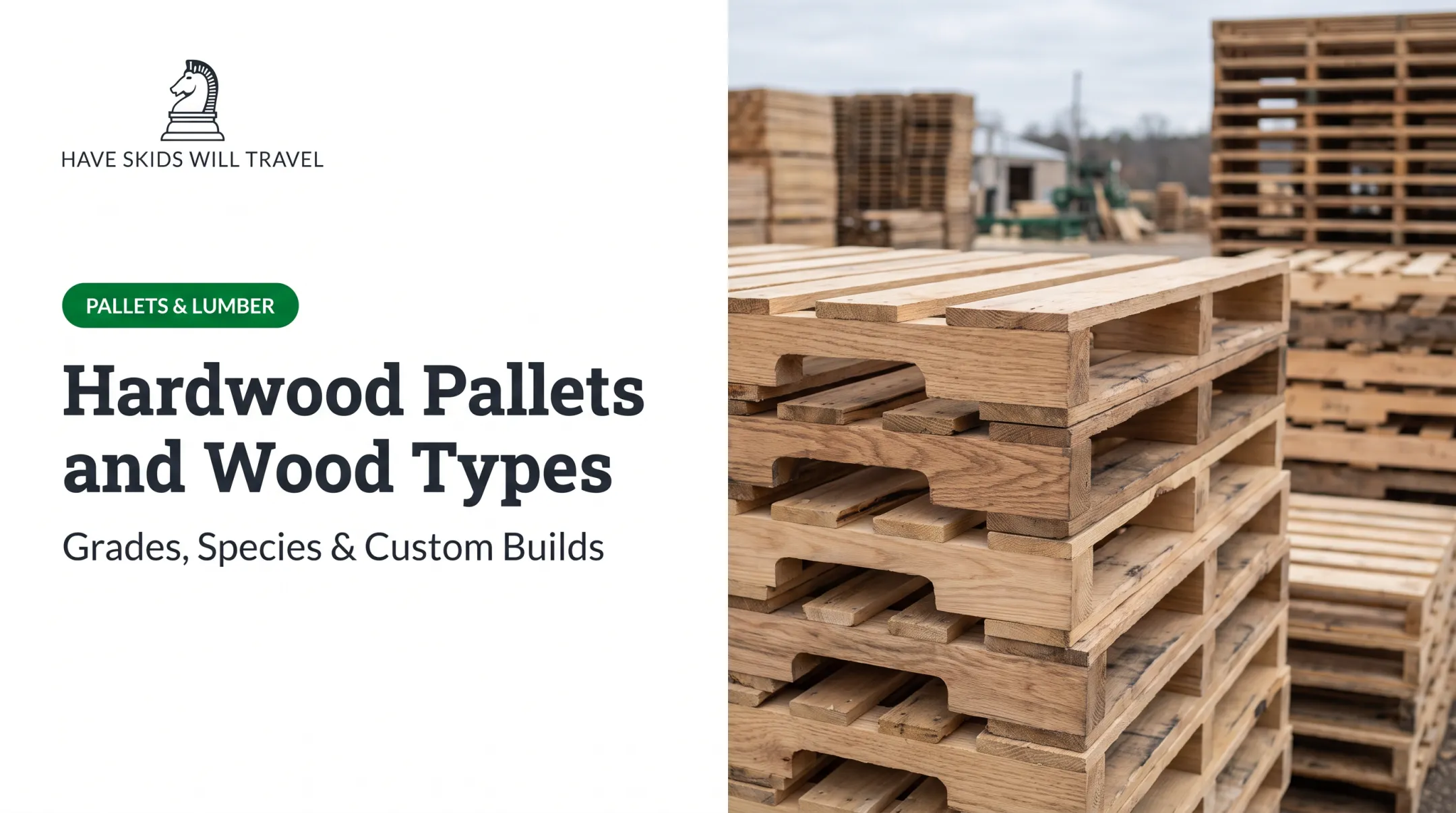
Wood species drives durability, weight, and cost. According to a USDA Forest Service study of the US pallet industry, hardwood made up 63.6% of pallet material by volume, with oak alone accounting for nearly 27% of hardwood use. Southern pine dominated the softwood side.
- Hardwood (oak and similar species): denser, generally stronger, better suited to heavy-duty and repeated-use pallets
- Softwood (pine and similar species): dries more economically, resists mold better in humid conditions, typically costs less
The right call depends on load weight, handling frequency, and budget. Heavier, high-cycle applications tend to lean hardwood. Standard-duty, cost-sensitive shipments often do fine with softwood.
Standardized Sizing Matters
The 48"x40" GMA footprint isn't arbitrary. It supports automation, four-way forklift entry, and high-volume logistics across the supply chain. That compatibility is why it dominates warehousing and retail distribution.
Palleton manufactures both hardwood and softwood pallets in this standard 48"x40" size, along with fully custom pallets and crates for non-standard loads.
For international shipments, Palleton also offers ISPM-15 heat treatment: kiln heating to a minimum core temperature of 140°F for at least 30 minutes. Every treated unit receives the compliance mark customs inspectors look for.

Skid and Pallet Sizing and Weight Capacity
Pallets follow relatively predictable sizing. Skids don't.
Pallet sizing and capacity examples:
- Standard GMA pallets: 48"x40" footprint, roughly 6.5 inches tall, with a minimum load-bearing capacity around 2,500 lb per the GMA spec
- Heavy-duty block pallets: rated up to 2,800 lb depending on construction
- Some heavy-duty pressed wood pallets list floor capacities above 7,500 lb—not the same as a forklift rating
Skids, by contrast, are sized to the product they support. There's no universal skid dimension or published capacity range. A skid built for a 3,000-pound engine block uses thicker, wider runners and a stronger deck than one built for a lighter fixture.
A few factors determine how much weight any wooden platform can safely carry:
- Wood species - hardwood generally outperforms softwood at equal dimensions
- Stringer or runner count - most pallets use three stringers; skids rely on runners, and heavier loads may need more of either
- Deck board thickness - thicker boards distribute weight more evenly
- Load distribution - uneven loading reduces effective capacity even on a well-built platform

Don't compare a "floor rating" to a "fork rating" and assume they're the same number. They're not, and mixing them up is a fast way to overload a platform that wasn't rated for the job.
Cost Considerations: Skids vs. Pallets
Skids are typically the cheaper option, and the reason is simple: they skip an entire deck's worth of lumber and fasteners. Less material, less labor, lower cost.
Pallet pricing works differently. Several variables push the price up or down:
- Wood type: Hardwood generally costs more than softwood
- New vs. recycled/combo: Recycled 48"x40" pallets have historically priced below new GMA units
- Volume and grade: Multi-use pallets built to last cost more upfront than limited-use units
Recycled stock and buy-back programs are how many buyers keep those variables in check. Palleton offers 100% recycled pallets, combo pallets that blend new and used components, and buy-back/core-recovery programs for common sizes like 48"x40" four-way GMA pallets.
Over the life of a shipping program, that mix can lower total pallet spend and cut waste headed to the landfill.
How to Choose the Right Platform for Your Supply Chain
Before ordering either one, ask a few direct questions:
- How often will this load move? Frequent handling favors pallets. Stationary equipment favors skids.
- Does it need to stack? Pallets, particularly block-style, stack reliably. Skids generally don't.
- Is this shipment crossing a border? Export loads need ISPM-15 heat-treated wood packaging.
- What equipment will handle it? Forklifts and pallet jacks need proper deck clearance, which only pallets reliably provide.
As a rule of thumb:
- Pick skids for stationary heavy equipment, machine shop fixtures, or one-time-use industrial loads
- Pick pallets for repeated shipping, warehouse stacking, or automated handling systems
Once you know which platform fits, match the build to your industry and shipping lanes. Palleton has spent more than 45 years building right-fit pallet and crate solutions across seven facilities, including its own lumber mill.
The company ships to businesses across the Midwest—useful when a pharmaceutical load needs a different spec than automotive components or bulk grain.
Frequently Asked Questions
What is the average cost of a wood pallet?
Costs vary widely based on size, wood species, and whether the pallet is new, recycled, or combo. Request a quote based on your specific load and volume for accurate pricing.
Is a skid the same as a pallet?
No. A skid has only a top deck on runners, while a pallet includes a bottom deck. That extra deck improves load distribution, stacking ability, and forklift compatibility.
How much weight can a wooden skid hold?
There's no universal skid capacity range since skids are built to match the product they support. Construction quality, wood species, and runner spacing all affect the actual limit.
What are skids used for?
Skids commonly support heavy machinery, dies, molds, and oversized industrial equipment. They're ideal for temporary or stationary applications where the load rarely moves.
Which wood is best for a wooden pallet?
Hardwood, like oak, generally offers greater strength and durability for heavy-duty use. Softwood, like pine, costs less and resists mold better, making it a solid fit for standard-duty applications.
How big is a skid?
Skid sizes vary far more than standard pallets since they're built around the specific product they'll support. There's no single standard skid dimension.