
Many operations managers don't think about pallet entry design until a forklift operator can't get a fork into the right side, and the whole dock backs up. That's a handling problem, not an equipment problem. Choosing between these two builds affects your handling speed, warehouse layout, damage rates, and total pallet spend.
This guide breaks down the construction differences, where each design fits best, and how to pick the right pallet for your supply chain.
Key Takeaways
- 2-way pallets allow forklift entry from two sides only; 4-way pallets allow entry from all four sides
- 4-way designs offer more handling flexibility; 2-way designs are typically simpler and cost less
- Your equipment, dock layout, and shipment frequency should drive the decision
- Both types are available new, recycled, or custom-built to match your operation
2-Way vs 4-Way Pallets: Quick Comparison
| Factor | 2-Way Pallet | 4-Way Pallet |
|---|---|---|
| Cost | Lower: solid stringers use less material and labor | Higher: notching or block construction adds manufacturing steps |
| Construction | Solid stringers, openings on two opposite sides | Notched stringers or blocks, openings on all four sides |
| Handling | Requires alignment; less flexible in tight spaces | Enter from any direction; less repositioning |
| Durability | Solid stringers resist breakage well | Block designs support heavy loads; notched stringers can be more vulnerable to side damage |
| Best fit | Predictable, one-directional dock flow | High-throughput, automation-compatible, multi-facility use |

Neither design has a universally documented damage-rate advantage. Pallet quality and handling practices matter more than entry style alone, according to Virginia Tech research on automated warehouse performance.
What Is a 2-Way Pallet?
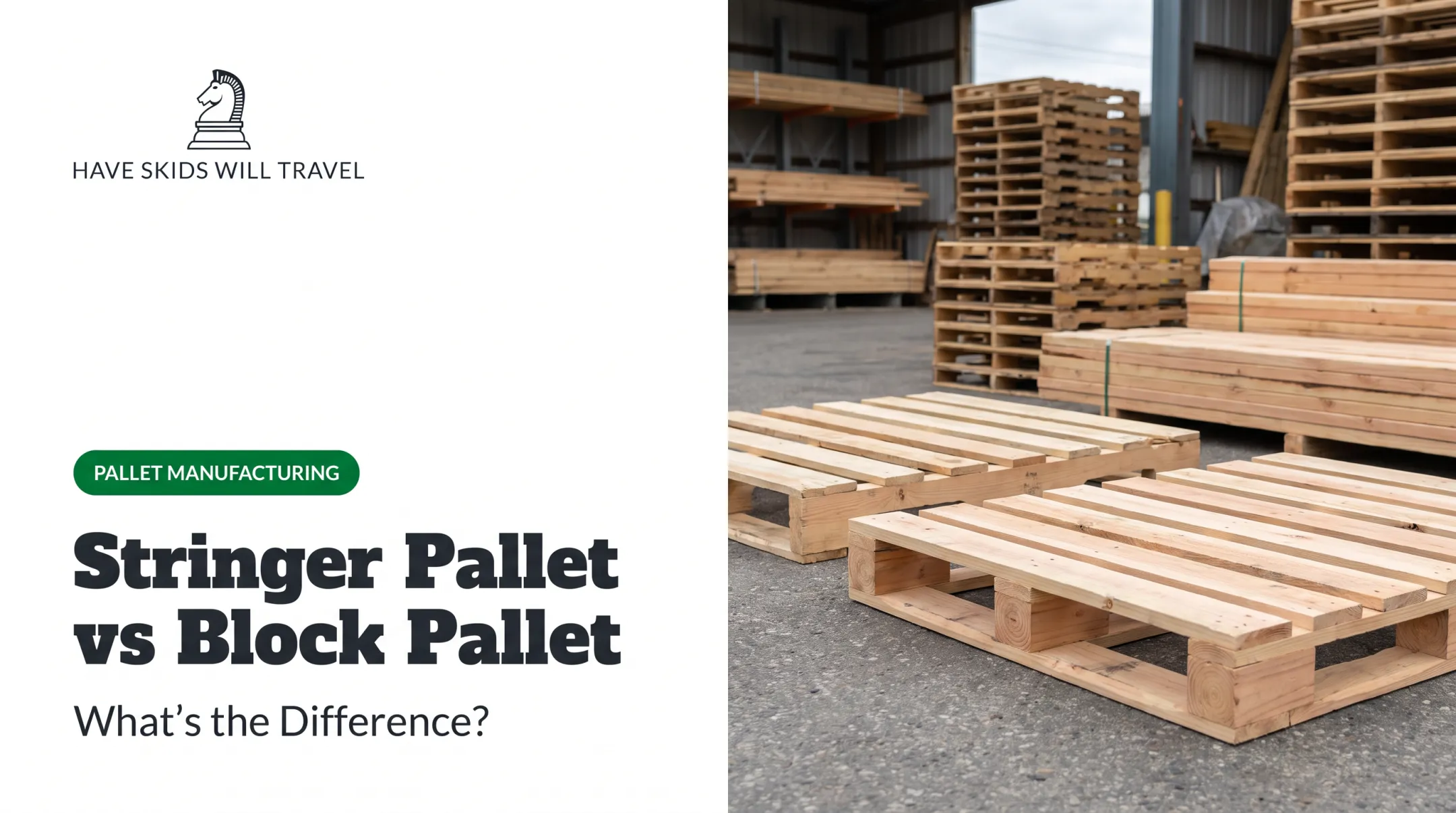
A 2-way pallet is a stringer pallet with solid, uninterrupted stringer boards running the length of the unit. Forks or a hand truck can only enter from the two open ends — the solid stringers block side access entirely.
This simplicity is the whole appeal. Solid-stringer construction uses less wood, requires no notching operation, and is easier and cheaper to repair than a block or notched design.
Where 2-Way Pallets Make Sense
- One-way shipments where the pallet won't be reused or re-entered from another angle
- Static storage where alignment isn't a concern
- Facilities with generous aisle space for straight-on forklift approach
- Predictable, single-route operations like certain agricultural or retail distribution setups
Solid-stringer construction costs less to manufacture than notched designs because it skips the extra machining step and uses fewer components. When dock flow is consistent and crews always approach from the same two sides, those savings add up quickly on high-volume orders.
Palleton's standard 48"×40" GMA stringer pallets fall into this category — a straightforward, budget-friendly option for businesses that don't need omnidirectional access.

What Is a 4-Way Pallet?
A 4-way pallet allows entry from all four sides. Manufacturers achieve this one of two ways:
- Block construction — solid blocks connect the top and bottom decks, creating true 4-way access for both forklifts and pallet jacks
- Notched stringers — cuts in the stringer boards create side openings, giving forklift access on all sides, though pallet jack entry can be limited

That distinction matters more than most buyers realize. A "partial 4-way" notched pallet isn't identical to a full block pallet, and knowing which one you're getting affects whether your pallet jacks can actually use it.
Where 4-Way Pallets Make Sense
- High-volume warehouses where dock congestion is a real bottleneck
- Multi-facility supply chains where pallets get handled by different teams and equipment
- Automated systems that require block-class or full 4-way pallets for AS/RS and conveyor compatibility
- Food and beverage, pharmaceutical, automotive, and export operations that need fast, flexible handling in multiple directions
Industry research on automated warehousing found that block-class pallets were the most common choice in semi-automated and fully automated facilities, with stringer-class recycled pallets close behind. A Virginia Tech case study on pallet design and warehouse performance shows 4-way and block designs tend to dominate wherever automation is involved.

If your facility runs conveyors or automatic retrieval systems, checking pallet compatibility before you order is worth the extra five minutes.
2-Way vs 4-Way Pallets: Which Should You Choose?
There's no universal right answer here. It depends on how your operation actually moves product. Ask yourself:
- What equipment are you using: forklifts, pallet jacks, or both?
- How much dock and aisle space do you actually have?
- How heavy are your loads, and how often do pallets change facilities?
- Are you shipping one-way, or do pallets circulate through multiple handlers? General rule of thumb:
- Choose 2-way if shipping direction is fixed, budget is tight, and your team can align equipment on the correct sides
- Choose 4-way if speed, flexibility, and space efficiency matter more than construction cost, especially with automation or multi-facility handling Once you know which entry style fits, the next step is matching the build to your equipment and supply chain. Palleton's custom pallet and crate manufacturing lets you spec 2-way or 4-way designs, or a mix of new and recycled materials, around how you actually handle loads. With over 45 years in the pallet and lumber industry and seven facilities including an in-house lumber mill, Palleton's team reviews product dimensions, load weight, and handling methods before recommending a build. If you're not sure which entry style fits your dock, sort that out before you place a large order.
Frequently Asked Questions
What is the difference between a 2-way pallet and a 4-way pallet?
A 2-way pallet allows forklift or pallet jack entry from two opposite sides through solid stringers. A 4-way pallet allows entry from all four sides, using notched stringers or block construction.
What is a 4-way pallet?
A 4-way pallet is designed for entry from all four sides, typically built with blocks or notched stringers. This gives handling equipment more flexibility to approach from any direction.
How much does a 4-way wooden pallet weigh?
Weight varies by lumber species, dimensions, and construction. Block-style 4-way pallets tend to weigh more than notched-stringer versions. Check with your supplier for exact specs on your specific build.
What are the two types of pallets?
Pallets fall into two main groups: entry style (2-way vs. 4-way) and construction (stringer vs. block). Together, those choices determine what equipment can access the pallet and from which sides.
What is the difference between #1 and #2 pallets?
#1 and #2 refer to pallet quality grades based on board condition and repair history — not entry style. Higher grades generally mean fewer repairs and better structural condition, which affects both durability and cost.
How big is a double pallet?
"Double pallet" typically refers to a larger footprint built by combining standard dimensions, but there's no fixed industry standard size. Sizing usually depends on the custom order and the load it needs to support.