
That confusion carries real costs. Choose the wrong platform and you risk product damage, wasted freight space, or a rejected export shipment at the port. More than 1.8 billion pallets are in service in the U.S. supply chain right now, and wood makes up 93% of them, according to the National Wooden Pallet and Container Association. With that much volume moving daily, getting the platform right matters.
This guide breaks down the structural differences between skids, pallets, and crates, where each one makes sense, and how to choose confidently for your next shipment.
Key Takeaways
- Pallets use top and bottom decks for rack stability; skids skip the bottom deck and usually cost less
- Crates fully enclose the load and give the highest protection for fragile or high-value freight
- Your choice hinges on load weight, fragility, mobility needs, and whether the shipment crosses a border
- Palleton builds custom pallets, crates, and ISPM-15 heat-treated export packaging under one roof—simplifying sourcing and reducing supply disruptions
What Is a Shipping Skid?
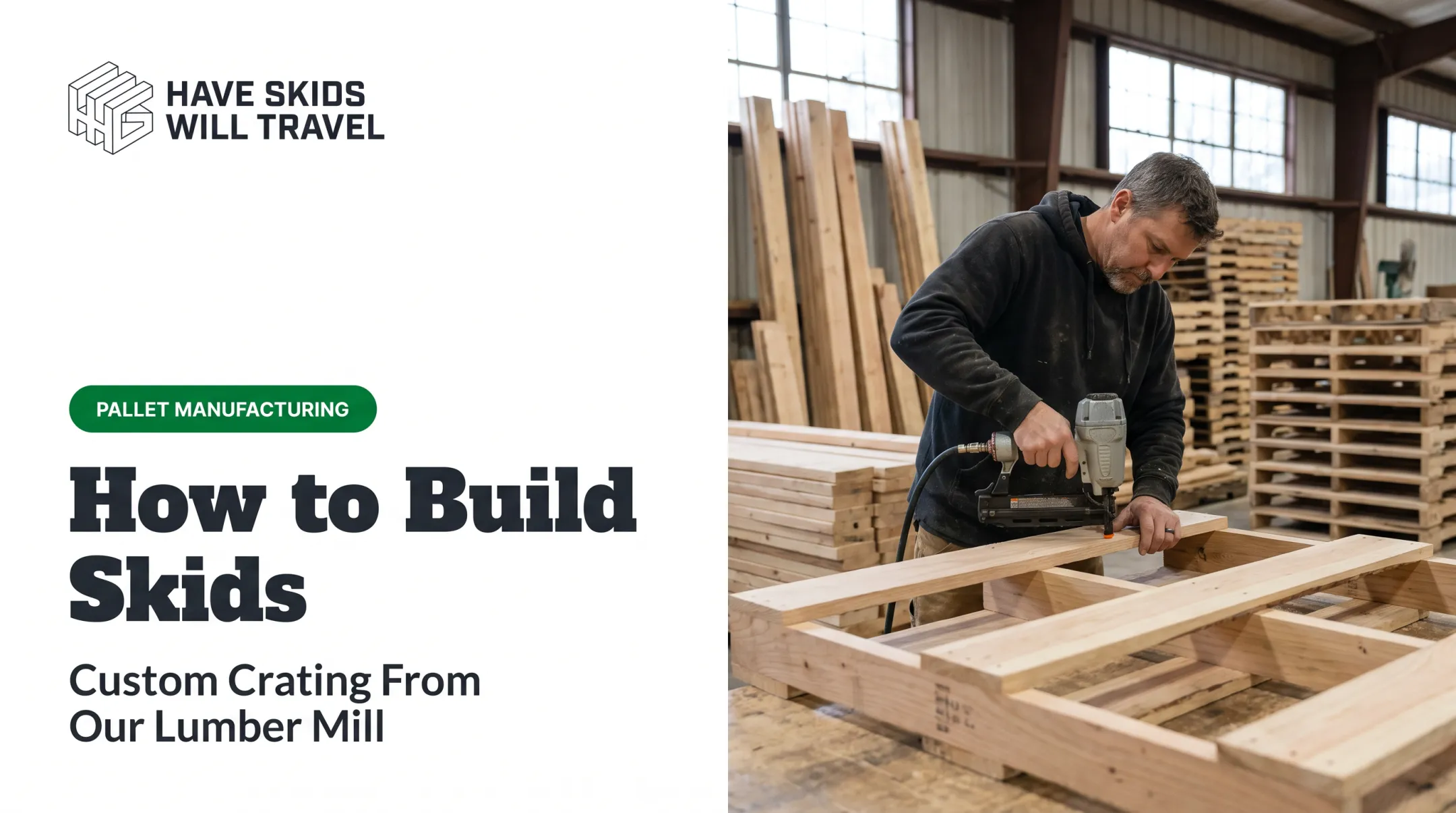
A skid is a pallet stripped down to its runners, with no bottom deck boards. Industry glossaries define it plainly: a skid is a pallet that doesn't have a bottom deck. That single missing component changes how the unit handles, stacks, and moves.
Skids are often considered the original pallet design. Less material means lower cost. No bottom deck also means no stacking stability, so they're not built for racking.
How Skids Get Used
Skids show up in a few specific scenarios:
- Dragging heavy machinery or equipment across a floor
- Serving as a permanent mounting base for stationary equipment
- Nesting together to save storage space when not in use
Unlike standardized pallets, skid dimensions are usually built around the load itself rather than a catalog size. If you're shipping an oddly shaped piece of equipment, the skid gets designed to match.
Four Common Skid Types
- Standard runner skid: basic parallel runners supporting a deck, no frills
- Notched/four-way skid: runners are notched so forklifts can enter from any side
- Custom-engineered skid: built to match unusual load shapes or weights
- Nestable skid: designed to stack inside one another for compact storage

What Is a Pallet?
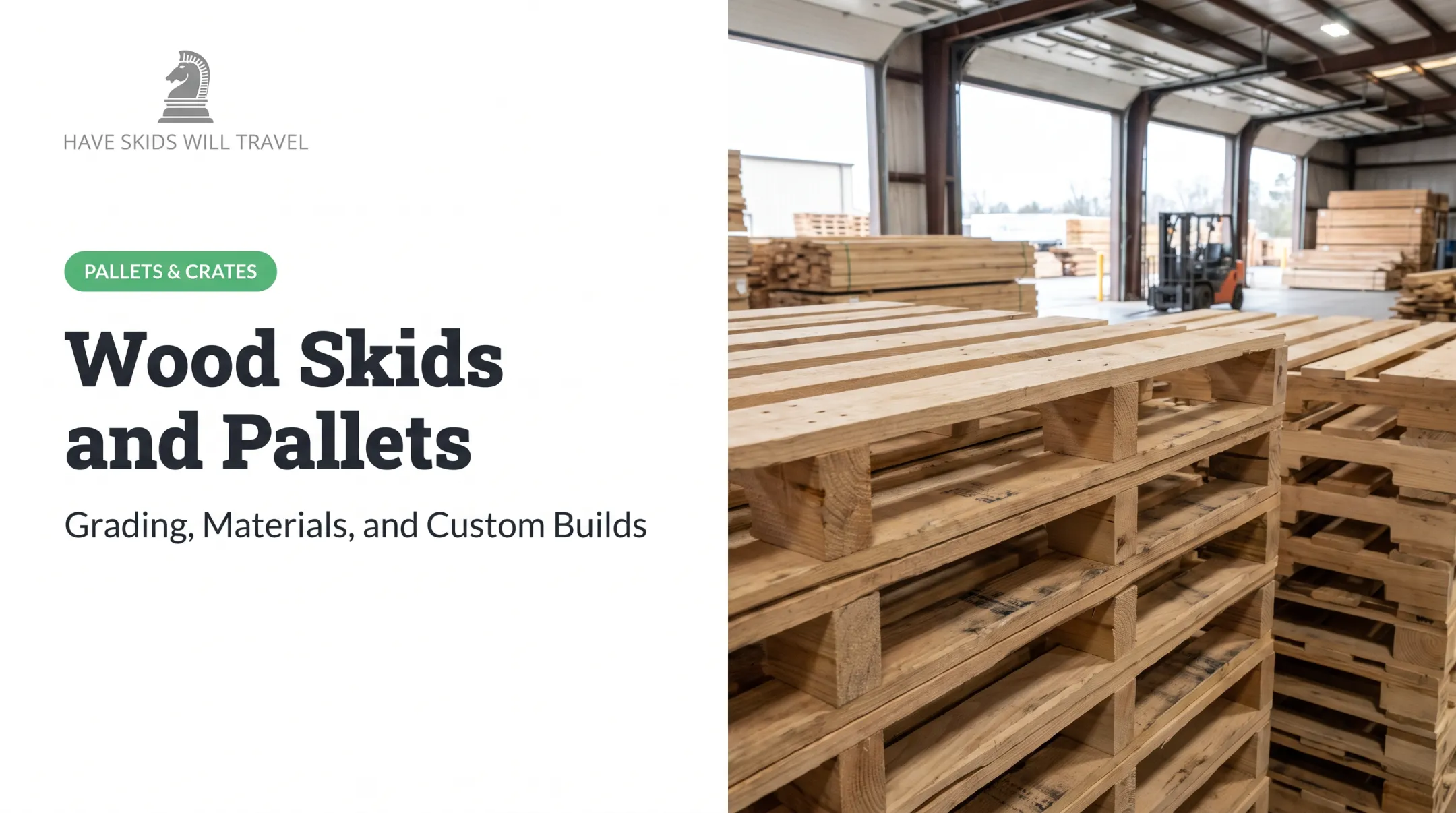
A pallet adds a bottom deck to the skid design, and that changes its whole handling profile. The result is a platform built for stacking, racking, and repeated forklift entry.
In the U.S., the reference size is 48x40 inches, often called the GMA pallet. It's the most recognized footprint, though NWPCA notes that only about one-third of all pallets actually use that exact size. Don't assume every pallet quote matches this standard until you confirm dimensions.
Why the Bottom Deck Matters
The bottom deck gives forklifts a consistent surface to lift from underneath, which improves:
- Compatibility with warehouse racking
- Stable stacking on warehouse floors
- Durability through repeated handling cycles
Block vs. Stringer Construction
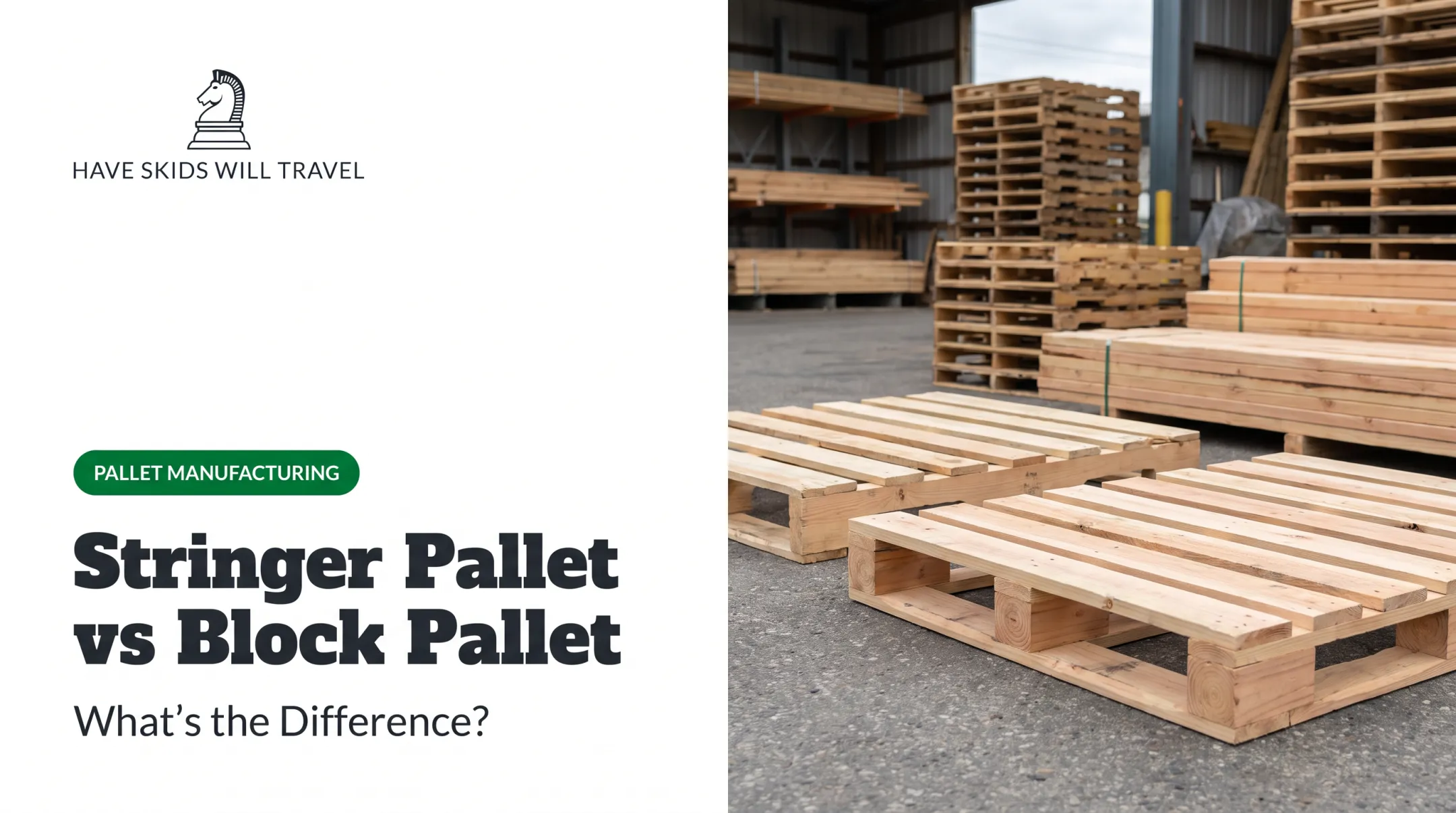
Stringer pallets use parallel boards (stringers) between the deck boards. Notched stringers allow four-way forklift entry, though lifts from the stringer ends are usually more stable.
Block pallets use separate blocks between the decks instead of continuous stringers, so four-way entry is typical without notching.

Reducing Pallet Spend
Palleton offers a few paths for businesses trying to control pallet costs:
- Reusable/repaired pallets — inspected and repaired in-house, since most wooden pallets can handle multiple repair cycles
- Combination pallets — mix new and used lumber for a middle-cost option
- 100% recycled pallets — lowest-cost option that also supports sustainability goals
Several of these options can pair with buy-back programs, where used pallets are returned and credited toward future orders—helping cut waste and lower ongoing spend.
What Is a Shipping Crate?
A crate isn't a base at all. It's an enclosure, four walls and a floor, built around the product rather than under it.
That distinction matters when you're shipping something fragile, high-value, or irregularly shaped. Full custom crates fit these loads: delicate machinery, electronics, oversized freight, or anything traveling internationally where handling is less predictable.
Crates often sit on a skid or pallet base, combining the structural support of a platform with the full protection of an enclosure. That combination adds strength on the bottom and security on all sides.
The trade-off is straightforward:
- Extra protection for long-distance or international freight
- Higher cost than an open platform
- Bulkier cube (more footprint) in the truck or container
For a $50,000 piece of manufacturing equipment heading overseas, that extra cost is cheap insurance. For a pallet of canned goods heading across state lines, it's overkill.

Skid vs. Pallet vs. Crate: Key Differences Compared
| Criterion | Skid | Pallet | Crate |
|---|---|---|---|
| Deck structure | Runners only, no bottom deck | Top and bottom decks | Fully enclosed box |
| Typical cost | Lowest | Moderate | Highest |
| Mobility | Easy to drag, not stackable | Forklift and rack friendly | Bulkier, needs a base |
| Load protection | Minimal | Moderate | Maximum |
| Best use case | Heavy equipment, permanent mounts | Standard warehouse and freight movement | Fragile, high-value, or international goods |
Friction matters here. A skid without a bottom deck contacts the floor differently than a pallet, which affects how easily it drags versus how well it sits still on a rack. If your equipment needs to stay put in a fixed position, confirm that difference with your supplier before you order.
Skids, pallets, and crates can all be built from wood, plastic, or metal. In practice, wood remains the dominant material for custom industrial shipping, thanks to its cost, repairability, and availability.
Don't Skip ISPM-15 for Exports
If any wood platform is crossing an international border, it needs to meet ISPM-15 phytosanitary requirements. This standard exists to stop pest introduction through raw wood packaging, and it applies to skids, pallets, crates, and dunnage alike.
Compliance means heat treating the wood core to at least 140°F for a minimum of 30 minutes. The unit then needs an approved stamp with the IPPC symbol, country code, facility code, and HT treatment code. Palleton's ISPM-15 heat treat certification follows this exact process, giving exporters a documented mark that inspectors recognize at the border. Skip this step and your shipment can get held up or rejected entirely.

How to Choose the Right Option for Your Shipment
Run through this checklist before you commit to a platform:
- Evaluate the product first — weight, fragility, and dimensions determine whether you need an open platform or a full enclosure
- Confirm the shipping lane — domestic freight has different requirements than an export shipment needing ISPM-15 compliance
- Check storage and handling needs — if the load will be racked or stacked, a pallet's bottom deck becomes non-negotiable
- Match the platform to the equipment — permanent machinery mounts often call for a custom skid rather than a standard pallet
Working with a provider that handles custom manufacturing, standard and specialty pallets, crates, and heat treatment in one place cuts vendor back-and-forth.
Palleton's seven facilities, including a lumber mill and a dedicated pallet and crate shop, let businesses shipping pharmaceuticals, automotive parts, or oversized machinery source everything from one relationship instead of juggling three suppliers.
Frequently Asked Questions
What is the difference between a skid and a pallet?
A pallet has a bottom deck for stability and rack compatibility, while a skid has only runners underneath. That makes skids lighter, generally cheaper, and easier to drag, but not suited for stacking or racking.
What is a skid vs. crate?
A skid is an open platform with no enclosure, built mainly for support and mobility. A crate is a fully enclosed box designed to protect fragile or high-value goods on all sides.
What is a skid in shipping?
A skid is a single-deck platform typically used for heavy, oversized, or permanently mounted equipment where stacking isn't required and simplicity keeps costs down.
What are the four types of skids?
The four common types are the standard runner skid, notched/four-way skid, custom-engineered skid, and nestable skid, each suited to different handling and storage needs.
How many skids is a truckload?
On a standard 48x40 footprint, skids and pallets load about the same: a 53-foot dry van typically holds 26 to 30 units, depending on orientation and stacking, per ATS trucking guidance. Custom skid sizes change that count.
How much is 1 pallet?
Pricing varies widely based on size, material, whether it's new or recycled, and order volume. The most reliable way to get an accurate number is to request a quote based on your specific load requirements.