
A formal pallet procurement policy fixes this before it becomes a crisis. It standardizes specifications, locks in supplier accountability, and protects your product, your workers, and your budget all at once. Pallets that fail in transit or storage drive up damage claims, create forklift and stacking hazards, and quietly inflate total supply chain costs — problems a documented policy is built to prevent.
This guide walks through building that policy step by step: defining requirements, setting specifications, qualifying suppliers, controlling purchasing decisions, and reviewing the policy as your business changes.
Key Takeaways
- A written pallet policy reduces damage, shortages, and inconsistent quality across facilities.
- Specifications should match load weight, handling equipment, and shipping lane, not just dimensions.
- Supplier qualification and scorecards create accountability beyond unit price.
- Exceptions need documented justification, approval, and an expiration date.
- Review the policy on a schedule and after major supply chain changes.
What a Formal Pallet Procurement Policy Should Include
Purpose, Scope, and Policy Objectives
The policy's purpose should tie directly to safe product movement, cost control, consistent quality, and reliable availability. Spell out what's covered:
- Facilities and departments included
- Product categories and pallet types (standard, recycled, custom, export, emergency)
- Purchasing activities governed, from recurring orders to one-off buys
Set measurable objectives using your own baseline data, not borrowed industry targets. If your damage rate last year was 4%, your objective might be cutting it to 2%. Don't invent a number because it sounds reasonable.
Roles, Responsibilities, and Approval Authority
No single department should make pallet decisions in isolation. Procurement needs input from operations, warehouse, quality, safety, finance, and sustainability teams before specifications or suppliers get locked in.
Define clearly:
- Roles authorized to request pallets
- Approvers for new suppliers
- Sign-off authority for purchases above a dollar threshold
- Owners of exception and emergency-order decisions
- Reviewers of supplier performance
Segregation-of-duties controls matter here. The person requesting a pallet shouldn't be the same person approving the purchase order, particularly for high-volume or custom programs.
Required Policy Components
A complete policy needs sections covering:
- Demand planning and specifications
- Supplier qualification and bidding requirements
- Purchase orders, delivery, and acceptance
- Nonconformance handling and invoice verification
- Recordkeeping and review cycles
Documentation requirements should include:
- Specification sheets and purchase history
- Inspection and rejected-load records
- Supplier agreements and certificates
- Corrective-action logs
Address how the policy applies to recurring programs versus one-time purchases, custom designs, national sourcing, and emergency procurement separately, since the approval path for each looks different.
Exceptions and Escalation Procedures
Buyers will occasionally need to deviate from standard specs (an unexpected shortage, rush shipment, or customer-specific requirement). That's fine, as long as it's controlled.
Every exception needs:
- Documented justification explaining why the deviation is necessary
- Risk review confirming the deviation won't compromise safety or product integrity
- Approval from the designated authority
- An expiration date so the exception doesn't quietly become the new standard

Build escalation paths for repeated quality failures, missed deliveries, unsafe pallets, billing discrepancies, or suspected supplier noncompliance. Escalation should trigger automatically after a defined number of incidents, not rely on someone remembering to flag it.
How to Develop the Policy Step by Step
Assess Current Pallet Demand and Business Requirements
Start by gathering data: pallet quantities by facility, product, lane, season, customer, and shipment type. Separate predictable recurring demand from project-based and emergency orders.
Document how pallets are currently purchased, stored, inspected, repaired, and disposed of. This usually surfaces problems nobody flagged before: duplicate vendors, inconsistent specs across facilities, and manual workarounds.
Talk to warehouse, shipping, production, quality, safety, and finance teams directly. Purchasing records alone won't capture everything; the forklift operator who deals with broken boards daily sees things a spreadsheet doesn't.
Convert Operational Needs into Pallet Specifications
Translate what you learned into concrete specs: dimensions, entry points, deck configuration, stringer or block design, wood grade, fasteners, repair standards, and markings.
Match the pallet to the job:
- Weight, dimensions, and center of gravity of the product
- Stacking pattern and storage system
- Handling equipment (forklift, pallet jack, conveyor, automation)
- Expected reuse cycle
Food and beverage, pharmaceutical, chemical, automotive, and export shipments often need their own specification sheet. A standard 48×40 GMA stringer pallet works for general warehouse shipments, but a 2,500-pound chemical drum needs a different deck and stringer design entirely. Decide upfront when new, recycled, combo, or heat-treated pallets are acceptable substitutes.
Build the Purchasing and Sourcing Process
Map the full path: internal request → specification review → quotes → supplier selection → purchase-order approval → delivery → inspection → invoice matching → payment.

Compare suppliers on more than unit price. Freight, lead time, minimum order quantities, quality consistency, and end-of-life options all affect true cost. This is where the traditional "five rights" of purchasing apply directly to pallets. CIPS's purchasing glossary defines them as right quantity, right quality, right time, right place, and right price:
| Principle | Pallet Procurement Application |
|---|---|
| Right Quality | Matches spec and load requirements |
| Right Quantity | Avoids shortage or excess inventory |
| Right Time | Meets production and shipping schedules |
| Right Place | Delivered to the correct facility or dock |
| Right Price | Reflects total cost, not just unit price |
Use a risk-based approach: low-value recurring orders might skip competitive bidding, while a new custom crate program for export likely needs technical validation and management sign-off.
Qualify and Score Suppliers
Set minimum requirements: production capacity, geographic reach matching your lanes, quality controls, insurance, financial stability, and references.
Build a scorecard tracking:
- On-time delivery rate
- Order accuracy
- Defect or rejection rate
- Response time and documentation quality
- Corrective-action performance
Decide review frequency and who owns it. For high-volume or high-risk programs, site visits, sample inspections, or trial orders add a layer of validation worth the time investment.
Pilot, Approve, and Publish the Policy
Test the draft with one facility or product line first. This catches impractical approval steps or unclear specs before you roll out company-wide.
Get sign-off from procurement, operations, quality, safety, finance, and executive stakeholders. Then publish it as a controlled document with an owner, effective date, revision history, and links to supporting specs and scorecards.
Pallet Specifications, Safety, and Compliance
Define Specifications and Acceptance Criteria
Specifications should cover:
- Dimensions and load capacity
- Construction, condition, and cleanliness
- Moisture content, repair quality, and markings
- Compatibility with handling equipment, racking, and trailers
Build an acceptance checklist that separates design requirements from receiving tolerances:
| Condition | Acceptable | Reject |
|---|---|---|
| Minor surface scuffing | Yes | — |
| Broken or cracked boards | — | Yes |
| Protruding nails or fasteners | — | Yes |
| Excessive prior repairs | — | Yes |
| Unusual odor or contamination | — | Yes |
Photos or diagrams help when visual consistency matters, especially across multiple receiving locations with different staff.
Address Workplace Safety
Pallet-related hazards show up in storage, stacking, and handling. Under OSHA's materials handling standard, tiered storage must be stacked, blocked, and interlocked to prevent sliding or collapse, and storage areas must stay clear of hazards like tripping or fire risks.
Separately, 29 CFR 1910.22(a) requires walking-working surfaces to stay free of hazards like loose boards or protruding objects. These are binding workplace-surface rules, not a specific pallet-grading standard. Don't conflate the two when training staff.
Define clear steps for handling unsafe pallets:
- Isolate and label damaged units immediately
- Report to a designated supervisor
- Route for repair or disposal based on severity
- Identify who can authorize a return to service

Coordinate these rules with your existing forklift, hazard communication, and incident-reporting programs so pallet safety isn't siloed.
Address Export, Hygiene, and Industry-Specific Requirements
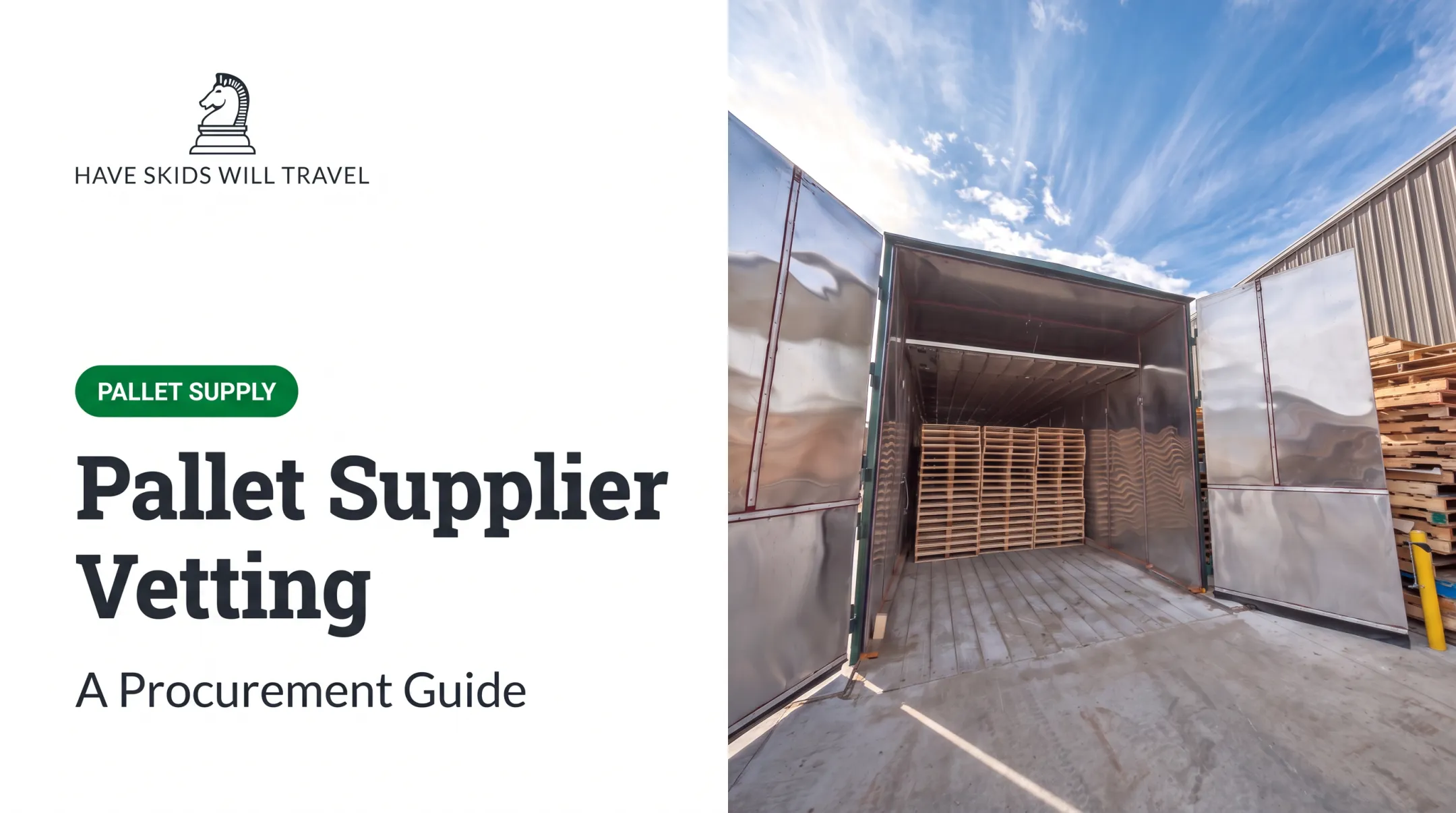
International shipments typically require ISPM-15-compliant wood packaging. The wood core must reach a minimum temperature during heat treatment, with documentation and a compliant stamp verified before the shipment leaves. Palleton's ISPM-15 heat-treat certification is an example of the kind of supplier credential worth confirming when export pallets or crates are part of your program.
Food, beverage, pharmaceutical, and chemical applications often need additional controls: cleanliness standards, washing, contamination prevention, or customer-specific traceability requirements. Palleton's food-grade washed pallet option reflects this kind of application-specific handling, which a policy should call out separately from general-purpose specs.
Supplier, Cost, and Risk Controls
Evaluate Total Cost of Ownership
Unit price is one line item among many. Factor in freight, handling, storage, inspection, repairs, product damage, disposal, and emergency sourcing costs when comparing options.
New, recycled, custom, rental, and buy-back pallets each carry a different cost profile across their full use cycle. Build a cost model specific to pallet type, facility, and product category rather than relying on a single blended number.

Use the 80/20 rule as a diagnostic tool, not a guarantee. A handful of pallet types, suppliers, or facilities often drive a disproportionate share of your spend or disruptions, but the exact split varies by organization. Verify it with your own data before acting on it.
Manage Supply Continuity and Market Volatility
Lumber prices and freight capacity fluctuate. Build in:
- Demand forecasts and seasonal ordering windows
- Safety inventory levels and lead-time buffers
- Backup suppliers for high-volume or critical programs
- A documented emergency procurement process that doesn't bypass quality checks
Avoid unnecessary single-source dependence, especially for programs tied to a single facility or lane.
Create Transparent Commercial Controls and Use Technology for Visibility
Standardize quote comparisons, purchase orders, delivery confirmations, and invoice matching. Define contract terms for lead times, fill rates, rejected loads, and price-change approval upfront, not after a dispute.
Shared tracking data keeps procurement and operations aligned. Palleton's encrypted cloud-based tracking, offering 24/7 access to inbound and outbound pallet details, is the kind of reporting capability worth evaluating when comparing supplier visibility tools. Confirm current features with any provider before finalizing a contract.
Embed Sustainability Requirements
Set evaluation criteria for recycled, repaired, and buy-back pallet programs where they meet safety and performance needs. NWPCA's recycling study estimates roughly 95% of wood pallets avoided landfill disposal in 2016, a useful industry reference point. Your own recovery and reuse numbers are what matter for tracking progress.
Measure waste reduction and recovery using your own operating data. Ask suppliers directly about material recovery, responsible sourcing, and end-of-life handling. Palleton's buy-back and core recovery options, along with mulching unusable wood for animal bedding, are examples of what to look for.
Put the Policy Into Practice and Improve It
Train Teams and Launch the Policy
Train everyone touching the process: requesters, buyers, warehouse staff, inspectors, receivers, and accounts payable. Provide quick-reference tools:
- Specification sheets
- Inspection checklists
- Approved-supplier lists
- Exception forms
Announce the effective date clearly, and explain how open orders, legacy pallet types, and urgent requirements transition into the new system.
Monitor Performance with Meaningful Measures
Track metrics like total cost of ownership, on-time delivery, fill rate, rejected pallets, damage incidents, and invoice discrepancies. Review results by supplier, facility, and pallet type — aggregate numbers can hide recurring problems at one location.
Set reporting frequency, accountable owners, and escalation thresholds for each measure so issues get addressed before they compound.
Review and Update the Policy
Schedule formal reviews after initial implementation, then at regular intervals — and after major changes in products, facilities, regulations, or suppliers. Use audit findings and supplier reviews to revise specifications and contingency plans. Document every revision and communicate changes before they take effect.
If you're building or revising a pallet procurement policy and want input from a supplier with over 45 years in the pallet and lumber business, Palleton works with companies across standard, custom, and export programs. A conversation about your specific requirements is a better starting point than a one-size-fits-all recommendation.
Frequently Asked Questions
What should a procurement policy include?
A complete policy covers purpose and scope, roles and approval authority, specifications, supplier qualification requirements, purchasing controls, safety and compliance standards, documentation rules, exception procedures, and performance review cycles.
What are the 7 steps of the procurement process?
For pallets, that's: identify demand, define specifications, source suppliers, evaluate and select, approve and order, receive and inspect, then monitor performance. Each step should connect to documented data, not guesswork.
What are the 5 R's of purchasing?
Right quality, right quantity, right time, right place, and right price. For pallets, this means matching specs to load requirements, ordering the correct volume, hitting delivery windows, shipping to the right facility, and evaluating total cost rather than sticker price alone.
What is the 80/20 rule in procurement?
It's a prioritization method for finding the small number of suppliers, pallet types, or facilities driving the largest share of spend or problems. The ratio isn't guaranteed to be exactly 80/20 — treat it as a starting point for analysis, not a fixed formula.
What are the specifications for pallets?
Specs typically cover dimensions, load capacity, construction type, entry points, wood grade, condition, cleanliness, repair standards, markings, and compatibility with your handling equipment. Export and industry-specific shipments often require additional requirements layered on top.
What are the OSHA rules for pallets?
OSHA's general industry standards address material storage stability, clear aisles, and walking-surface hazards under 29 CFR 1910.176 and 1910.22. These are binding workplace rules, not pallet-grading standards, so verify current requirements for your specific operation before finalizing training materials.